A client asked me this last month, holding up her phone with a reel that promised one avocado a day would "unclog your arteries." She wanted to know if it was worth ₹180 a week. My answer took twenty minutes, so here it is properly.
The short version
Avocado is genuinely good food. It's also not medicine. There is real research behind the heart-health claims, and I'll walk you through what it actually found — including the large trial that came back more underwhelming than the headlines suggested. But if you take one thing from this article, take this: the avocado is not the reason someone's cholesterol improves. The swap is. An avocado added on top of your usual butter-and-cheese sandwich does close to nothing. An avocado replacing the butter and cheese does something measurable. That distinction is the entire article. Everything below is detail.
What's actually in an avocado
Per 100g of avocado flesh (roughly half a medium one), you're getting: About 160 calories Around 15g of fat, most of it monounsaturated — the same family of fat that makes olive oil and groundnuts useful About 7g of fibre, which is a lot for a fruit Roughly 480mg of potassium, more than a banana of the same weight Almost no sugar, and very little starch That fibre number is worth pausing on. Most of my clients struggle to hit their daily fibre target, and a fruit that quietly delivers 7g per 100g is doing real work — for cholesterol, for digestion, and for how full you feel after lunch. The potassium matters too, for blood pressure. One caveat, and it's important: if you have kidney disease or your doctor has told you to restrict potassium, avocado is not a free food for you. Please check before adding it regularly. This is the single most common way I see "healthy food" advice go wrong.
What the research actually says about one avocado a day
Here's where most articles get vague. Let me be specific. The popular "one avocado a day" idea traces back to a small 2015 trial published in the Journal of the American Heart Association. Around 45 overweight adults ate one avocado daily as part of a moderate-fat diet, and their LDL cholesterol came down meaningfully compared to the control diet. Promising. Small, but promising. Then in 2022, researchers ran a much bigger version — the Habitual Diet and Avocado Trial, roughly 1,000 adults over six months, again in JAHA. This is the study that should be quoted more often and almost never is. The result: the main outcome they were testing, abdominal fat, didn't budge. Total cholesterol and LDL improved, but modestly. It was not the dramatic transformation the reels promise. I'm telling you the disappointing study because I'd rather you trust me than be impressed by me. The honest summary is: avocado appears to nudge cholesterol markers in the right direction, and the effect is real but small. It behaves roughly the way you'd expect any good source of unsaturated fat and fibre to behave. It is not doing something magical that groundnuts, walnuts or mustard oil can't also do. Which brings us to the question nobody writing about avocados wants to answer.
Is it worth the money in India?
Depends entirely on your budget, and I'd rather say this plainly than pretend cost doesn't exist. Avocados in Indian cities typically run somewhere between ₹80 and ₹250 per fruit depending on the season, the city, and whether it's imported or grown domestically — Coorg and parts of Karnataka now produce them, and those are usually cheaper. If that fits comfortably in your grocery budget, wonderful. It's a nutritious food and I'm happy to build it into your plan. If it doesn't, please don't feel you're missing out on something essential. A handful of groundnuts, a tablespoon of til or flax, a few walnuts, or cooking in mustard or groundnut oil gives you the same category of benefit — unsaturated fat plus fibre — at a fraction of the cost. I have clients who've brought their LDL down significantly and never eaten an avocado in their life. Nutrition advice that ignores what things cost isn't advice. It's marketing.
How much avocado should you eat?
Not a whole one, for most people. A quarter to half a medium avocado is a sensible everyday portion. Half a medium avocado is roughly 110–120 calories, which is easy to absorb into a normal day. A whole one is closer to 230–250, which is fine if you've planned for it and less fine if it's sitting on top of an already generous meal. Your right portion depends on your overall calorie needs, how active you are, whether weight loss is a goal, and how much fat you're already getting from oil, nuts and dairy across the day. Someone doing heavy physical work and someone with a desk job and a weight-loss target are not the same case. If you want that number worked out for your body and your routine rather than guessed at, that's the kind of thing I do in a consultation — but the quarter-to-half guidance will serve most people well in the meantime.
Can I eat avocado every day?
For most healthy adults, yes — there's nothing about daily avocado that causes harm, assuming the portion is reasonable and your potassium isn't restricted. But you don't need to. Nothing about a good diet requires any single food to appear daily. Three or four times a week is completely fine. Eating it because you enjoy it is a better reason than eating it because a trial protocol used a daily dose.
Is avocado good for high cholesterol?
It can help — as a replacement, not an addition. I keep repeating this because it's the step people skip. If your cholesterol is high, the changes that move the needle most are: cutting down saturated fat (ghee-heavy cooking, full-fat dairy in quantity, fried snacks, bakery items with palm oil), raising fibre substantially through dals, vegetables, whole grains and fruit, and replacing some of your existing fat with unsaturated sources. Avocado can be one of those unsaturated sources. So can a lot of cheaper things. What avocado will not do is offset a diet that's otherwise working against you. If your LDL is significantly elevated, this needs a proper evaluation with your doctor alongside diet changes — and sometimes medication. Please don't try to eat your way out of a number that needs medical attention.
Avocado, diabetes and weight loss
For diabetes: it fits well. Very low carbohydrate, decent fibre, unsaturated fat — it won't spike your blood sugar, and pairing it with a meal can slow the overall glycaemic response a little. The usual caution applies: a diabetes-friendly meal matters more than a diabetes-friendly food. Avocado on white bread is still white bread. For weight loss: it can absolutely be included, and the fat-and-fibre combination does help some people stay full between meals. But avocado does not burn fat, and I'd rather you hear that from me than discover it three months in. It's calorie-dense. Used as a swap for mayonnaise or cheese, it improves the meal without adding calories. Used as an extra, it quietly adds 200+ calories a day, which is enough to stall progress entirely. Same food. Opposite outcomes. Depends only on whether it replaced something or joined something.
Buying and storing, since nobody mentions this
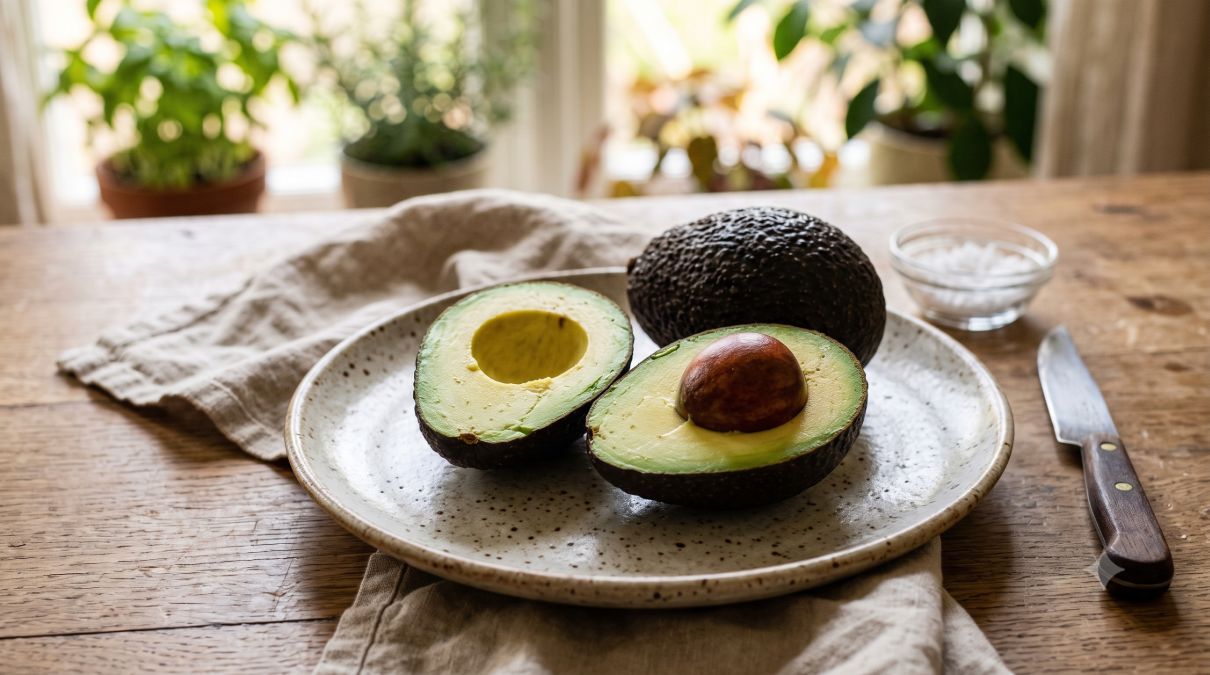
A ripe avocado gives slightly when you press near the stem — not the middle, which bruises. Rock hard means three to five days on the counter. If it feels hollow or dents easily, it's gone past. To speed up ripening, put it in a paper bag with a banana. To slow it down once ripe, refrigerate — it'll hold for a few more days. Cut surface goes brown fast. Lemon juice, cling film pressed directly against the flesh, and keeping the seed in the unused half all help a bit.
Five ways to eat it that aren't avocado toast
You don't need to eat like a Californian to use this fruit. Mash it with lemon, green chilli, coriander and a pinch of black salt and use it as a spread inside a whole-wheat roti roll with paneer and salad. Fold it into a chaat with onion, tomato, chaat masala and pomegranate — it works far better than people expect. Cube it into a rajma or chana bowl at the end. Spread it on multigrain toast under a poached egg. Or blend a small amount into a chutney to replace the coconut. The point isn't to build meals around it. It's an ingredient, not a centrepiece.
What I'd actually tell you if you were sitting across from me
Avocado is a good food. Include it if you like it and it fits your budget. But heart health isn't built out of individual foods. It's built out of what you eat most days for years — enough vegetables, enough protein, enough fibre, less saturated and trans fat, fewer packaged and fried things, plus movement, sleep, and keeping your blood pressure and blood sugar in range. No fruit outperforms that. Not this one, not the next one that goes viral.
References
-
[Lichtenstein AH, Kris-Etherton PM, Petersen KS, et al. Effect of Incorporating 1 Avocado Per Day Versus Habitual Diet on Visceral Adiposity: A Randomized Trial Habitual Diet and Avocado Trial. Journal of the American Heart Association, 2022.] (https://doi.org/10.1161/JAHA.122.025657)
-
USDA FoodData Central — Avocados, raw, all commercial varieties.