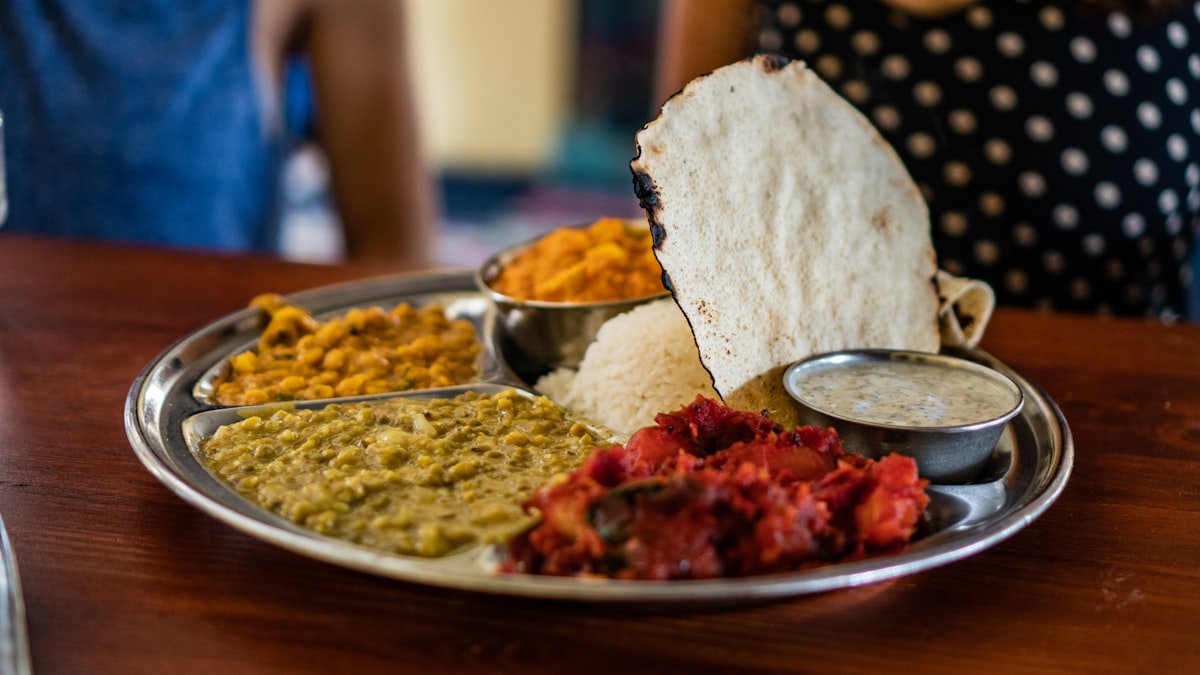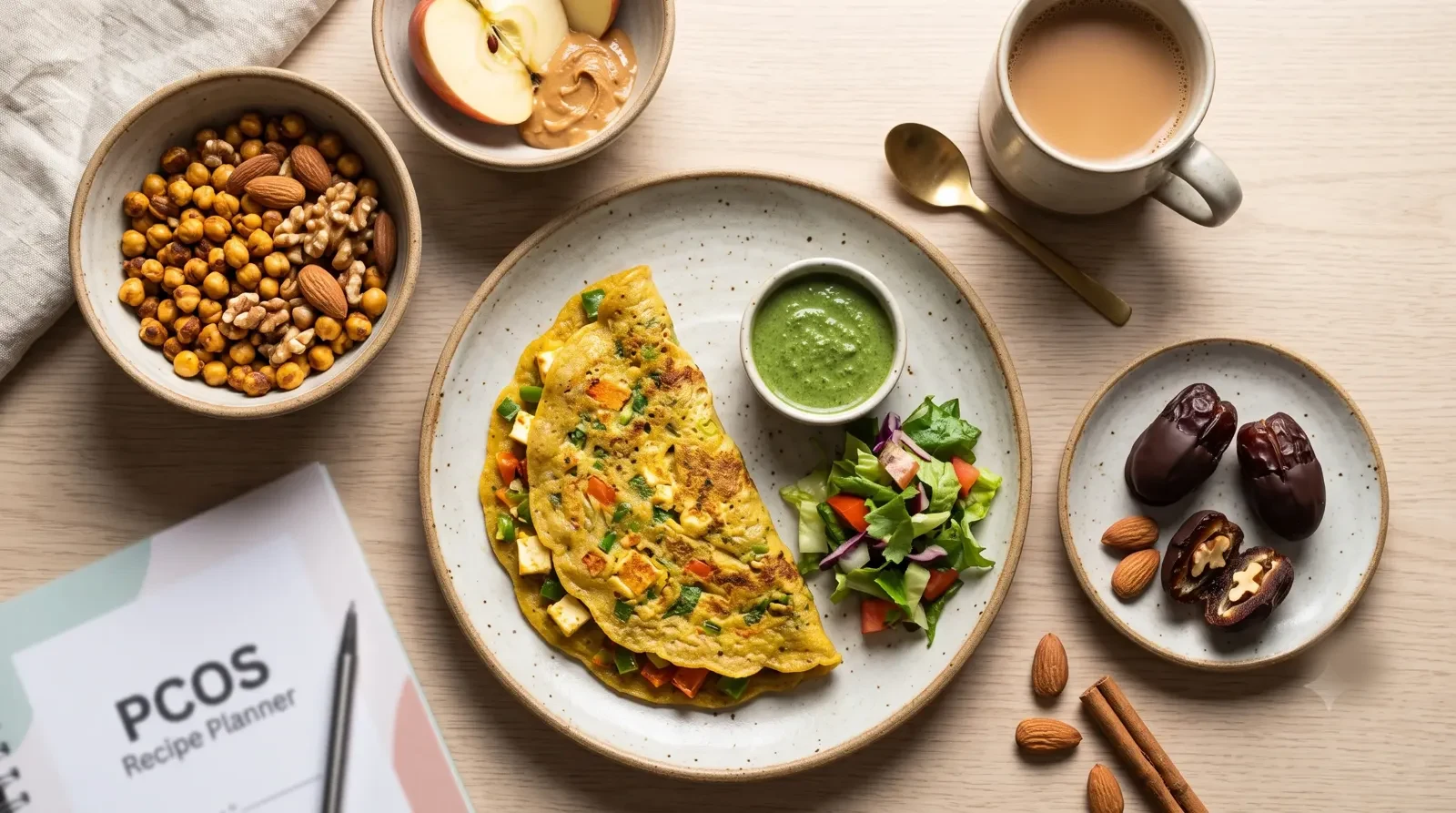
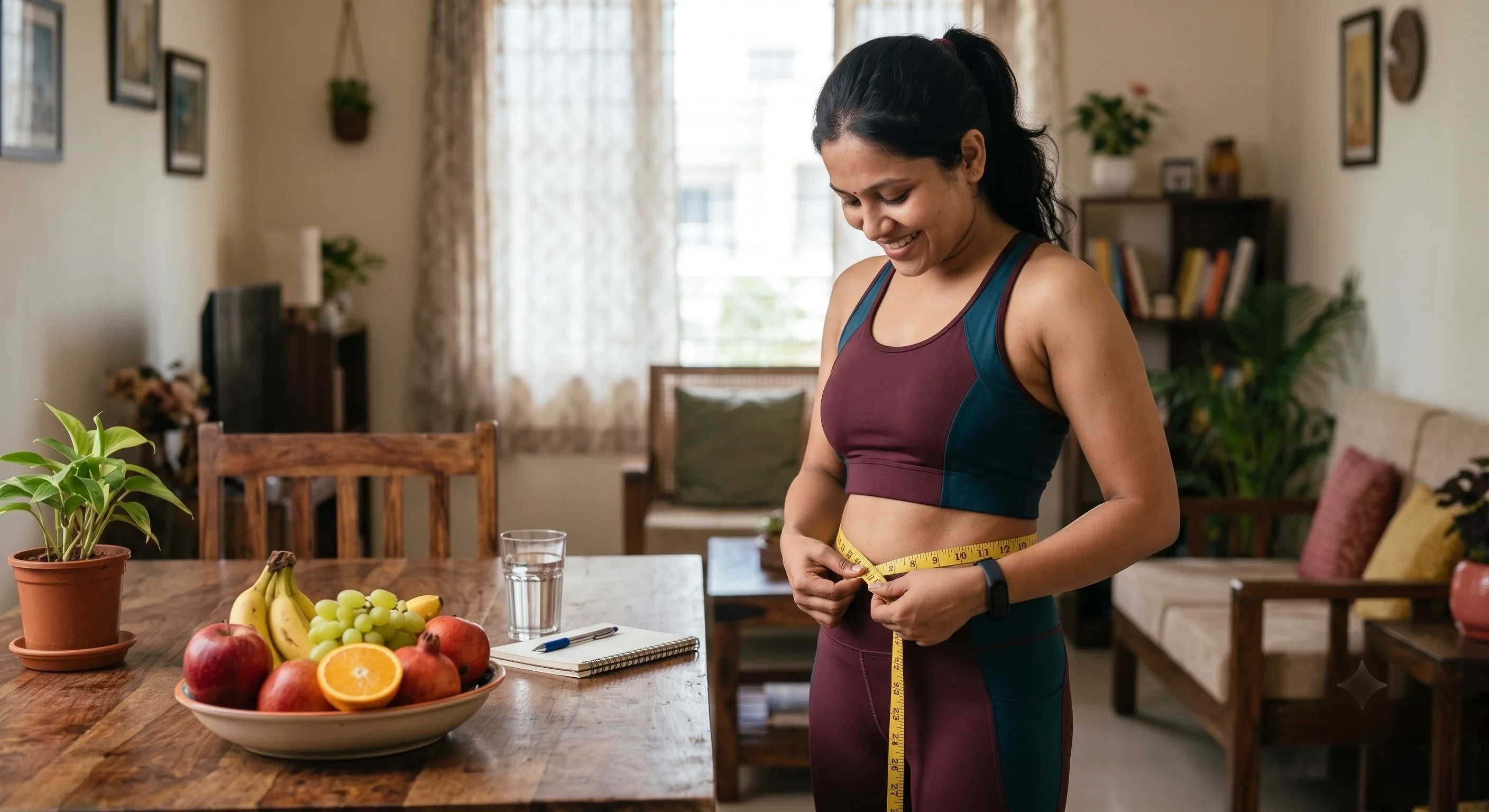
You cut rice. You started walking. You bought the sugar-free biscuits and the "PCOS-friendly" granola. Six weeks in, the scale hasn't moved — or it moved 2 kg and stopped dead.
Here's what I've noticed after 7 years of consultations: the women who come to me stuck with PCOS are almost never eating too much. Most are eating too little, too erratically, and too low in protein — and they're measuring their progress with the one tool that lies most in PCOS.
The seven mistakes below aren't generic weight-loss advice. They're the specific things I see going wrong in PCOS, in Indian kitchens, week after week.
First: why PCOS weight loss genuinely is harder
This isn't in your head, and it isn't a willpower problem.
Insulin resistance is present in a majority of women with PCOS — including many who are lean. When cells respond poorly to insulin, the pancreas compensates by producing more. Higher circulating insulin makes fat storage easier, fat release harder, and hunger and cravings louder. It also drives the ovaries to produce more androgens, which is what links the weight difficulty to the irregular cycles, the acne and the hair changes.
Two consequences matter for what follows:
Eating less makes it worse, not better. Aggressive restriction raises cortisol, drops NEAT (the calories you burn fidgeting, walking, moving), and costs you muscle — and muscle is the tissue that clears glucose from your blood. You end up with a slower metabolism and worse insulin sensitivity than you started with.
PCOS is not one condition. A lean woman with irregular cycles and normal insulin needs a different plan from a woman with significant insulin resistance and central weight gain. This is exactly why the Instagram "PCOS diet" fails most people who try it.
Mistake 1: Undereating — and calling it discipline
This is the single most common thing I see. Tea and two biscuits at 8 am. Nothing until 2 pm. A rushed lunch. By 7 pm the hunger is physical and unmanageable, and the evening turns into biscuits, namkeen and whatever is in the kitchen.
The woman then concludes she has no self-control. She doesn't. She has an eight-hour protein gap.
Long gaps with high circulating insulin produce sharper hunger than they would in someone without PCOS. The evening eating isn't a character flaw — it's the predictable output of the morning.
What to do instead: eat a real breakfast within 90 minutes of waking, with protein in it. Not because breakfast is magic, but because it prevents the 7 pm collapse.
| Instead of | Try |
|---|---|
| Chai + 2 biscuits | Moong dal chilla (2) + curd |
| Plain poha | Poha + peanuts + a boiled egg or paneer cubes |
| Idli + sambar only | Idli + sambar + a katori of curd, or add egg |
| Skipping entirely | Curd + fruit + a handful of nuts (60 seconds, no cooking) |
Mistake 2: A carb-heavy plate with protein as an afterthought
The typical Indian plate is structurally low in protein. Four rotis, a small katori of dal, sabzi. That's a carbohydrate meal with a protein garnish.
Protein matters more in PCOS than in general weight loss for two reasons: it blunts the glucose and insulin response of the meal it's eaten with, and it protects muscle mass while you're losing weight — which directly protects your insulin sensitivity.
The practical target: a palm-sized portion of protein at every main meal, and roughly 20–30 g at breakfast specifically, which is where almost everyone falls short. Treat these as general ranges — your own targets should be set with your dietitian based on body size, activity and clinical picture.
Indian protein, by rough amount per serving:
- Paneer, 100 g — 18 g
- Curd, 1 cup — 8–10 g
- Egg, 1 large — 6 g
- Dal or rajma, 1 katori cooked — 7–9 g
- Soya chunks, 30 g dry — 15 g
- Chicken or fish, 100 g — 22–25 g
- Sprouts, 1 cup — 8 g
Vegetarians: you will likely need a mix of dal, curd, paneer, soya and sprouts across the day rather than relying on one source. This is not optional in PCOS — it's the part of the plan that does the most work.
Mistake 3: Cutting dairy and gluten because Instagram said so
There is no strong evidence that dairy or gluten worsen PCOS in women without a diagnosed intolerance or coeliac disease.
I see the harm from this constantly. A woman removes curd, paneer and milk — three of the most accessible protein sources in an Indian vegetarian diet — and replaces them with almond milk and gluten-free crackers. Her protein intake collapses, her satiety collapses, and her PCOS is measurably worse two months later. She then blames herself.
If dairy genuinely causes you bloating or acne flares, that's your own data and worth acting on. If you removed it because a reel told you to, put it back.
The same applies to: detox waters, apple cider vinegar as a strategy, "PCOS tea," and any protocol that removes an entire food group without a clinical reason.
Mistake 4: Judging progress by the scale alone
PCOS involves hormonal fluctuation, and hormonal fluctuation involves water. Your weight can swing 1.5–2 kg across a cycle for reasons that have nothing to do with fat. If you're also doing strength training, you may be gaining muscle while losing fat and seeing a flat number.
Women quit good plans in week three because of this. It's the most avoidable failure in the whole process.
Track these instead, monthly:
- Waist circumference at the navel — more relevant than weight in insulin resistance
- How your clothes fit, particularly at the waist
- Cycle regularity — the outcome that actually indicates hormonal improvement
- Energy in the afternoon, and whether the 4 pm crash has gone
- Strength: are you lifting more or walking further than last month
- Bloodwork, if you're getting it checked periodically — fasting insulin, HOMA-IR, HbA1c and lipid panel
Weigh weekly at most, at the same point in your cycle, and only look at the monthly trend.
Mistake 5: Hours of cardio, no strength training
The instinct in PCOS is to burn more. So it's an hour on the treadmill, six days a week, often on top of an already low food intake.
This is backwards. Excessive cardio on inadequate fuel raises cortisol, and cortisol worsens central fat storage and insulin resistance — the exact two things you're trying to fix.
Resistance training does something cardio can't: it builds and preserves muscle, and muscle is where glucose goes. More muscle means better insulin sensitivity, independent of any weight change.
A realistic week:
- Strength training, 2–3 sessions. Full body. Bodyweight, resistance bands or dumbbells all work — you don't need a gym.
- Walking, 7,000–8,000 steps most days. Broken up is fine. A 10-minute walk after dinner has a measurable effect on post-meal glucose.
- Optional: one session of something you enjoy — dance, cycling, swimming.
That's it. Consistency at this level beats an intense six weeks followed by burnout, every time.
Mistake 6: Ignoring the rest of the clinical picture
Diet is one input. These are the ones I see missed:
Sleep. A single night of poor sleep measurably worsens insulin sensitivity the next day. If you're sleeping five hours and wondering why nothing works, start there before you change your diet.
Thyroid. Hypothyroidism is more common in women with PCOS and produces overlapping symptoms — fatigue, weight difficulty, cycle changes. If it hasn't been checked recently, ask your doctor.
Medication timing. If you're on metformin, taking it with food generally reduces GI side effects. If you're considering inositol, ask your doctor or dietitian about the right form and dose for you — this varies enough between individuals that it's worth getting personalized guidance rather than a generic number.
Vitamin D and B12. Deficiency is widespread in Indian women and both are worth checking. B12 especially if you're vegetarian or on long-term metformin.
None of this is something you self-manage. It's what you raise with your doctor.
Mistake 7: Building a plan that ignores your actual life
The plan fails on the days it didn't account for. In practice, that's most days.
Hostel or PG food: you can't control the mess menu, but you can add to it. Keep curd, eggs, roasted chana, peanuts and a fruit in your room. Add protein to whatever arrives rather than trying to replace it.
Office canteen and eating out: choose the dal, curd, paneer or chicken dish first, then decide the carb portion. Order a raita. Tandoori over gravy where there's a choice. This is a decision rule you can apply anywhere, not a food list to memorise.
South Indian breakfasts: idli, dosa and upma are carb-dominant on their own. Add curd, egg, or a generous portion of sambar with extra dal. Don't stop eating them.
Navratri, Karva Chauth, Ekadashi: fasting is not off-limits with PCOS, but going the whole day on sabudana and fried aloo will spike glucose hard. Build the fasting meal around curd, paneer, makhana, nuts and fruit, and keep the sabudana portion modest.
Weddings and long celebrations: eat a protein-containing meal before you go. Arriving hungry to a buffet is the problem, not the buffet.
What a PCOS-friendly Indian day actually looks like
Two versions. These are illustrative, not prescriptions — your portions depend on your body size, activity, medications and clinical picture, which is what an individual consultation is for.
Vegetarian
| Meal | Example |
|---|---|
| Breakfast (8–9 am) | 2 moong dal chillas + 1 cup curd + sautéed vegetables |
| Lunch (1–2 pm) | 2 whole-wheat rotis + 1 katori dal + sabzi + salad + 1 cup curd |
| Snack (5 pm) | 1 fruit + 15–20 almonds or roasted chana |
| Dinner (8 pm) | 100 g paneer or tofu + vegetables + 1–2 rotis |
Non-vegetarian
| Meal | Example |
|---|---|
| Breakfast | Vegetable poha + 2 boiled eggs |
| Lunch | 1 cup brown rice + 100 g chicken or fish curry + sabzi + salad |
| Snack | Curd + fruit |
| Dinner | Grilled fish or chicken + vegetables + 1 roti |
The structural principle, which matters more than the specific foods: every main meal has a protein source, a fibre source, and a controlled carbohydrate portion. Learn the structure and you can build it from any cuisine, in any kitchen, without a chart.
Where to start this week
Don't change everything. Change one thing:
Add 20 g of protein to breakfast. That's it. Do only this for two weeks.
For most women I see, this one change reduces evening cravings more than any other single intervention — because it fixes the deficit that causes them, rather than trying to out-discipline the result.
Once that's automatic: add two strength sessions a week. Then a ten-minute walk after dinner. One habit at a time, held for a fortnight before you add the next.
The bottom line
If you're stuck with PCOS weight loss, the answer is almost never to eat less. In my practice, it's usually the opposite: eat enough, eat protein at every meal, lift something twice a week, sleep properly, and stop measuring your progress with a scale that responds to your cycle.
You don't need a perfect diet. You need a structure you can hold for six months.
Work with me
I'm Dietitian Sanchi, M.Sc. Food & Nutrition. I work with Indian women managing PCOS to build nutrition plans around the food they already eat — no elimination diets, no imported ingredients, no protocols you'll abandon in three weeks. Click here to book your free consultation